Every AI capability in the product is non-diagnostic by construction. The way that constraint is enforced is the decision.
Every prose-generating call carries a safety instruction — no diagnoses, no starting, stopping or changing medication, deflect on emergencies. That is the part everyone does. The part that matters is what happens next: the output is checked in code, and anything that reads as medical advice is replaced with a safe deflection.
The failure mode this prevents is specific. A system prompt is a request to a probabilistic system, and the request is honoured most of the time. "Most of the time" is an acceptable standard for a summariser and an unacceptable one for a thing that might tell a diabetic to change their dose. A prompt is a request. A scanner is a control. Only one of them can be pointed at in an audit.
The same reasoning shapes the smaller defences. Text from an uploaded document is fenced off as untrusted input, so a prescription cannot pose as instructions to the model. And in the assistant, identity always comes from the session, never from the model: it can ask for a lab result, but it cannot choose whose.
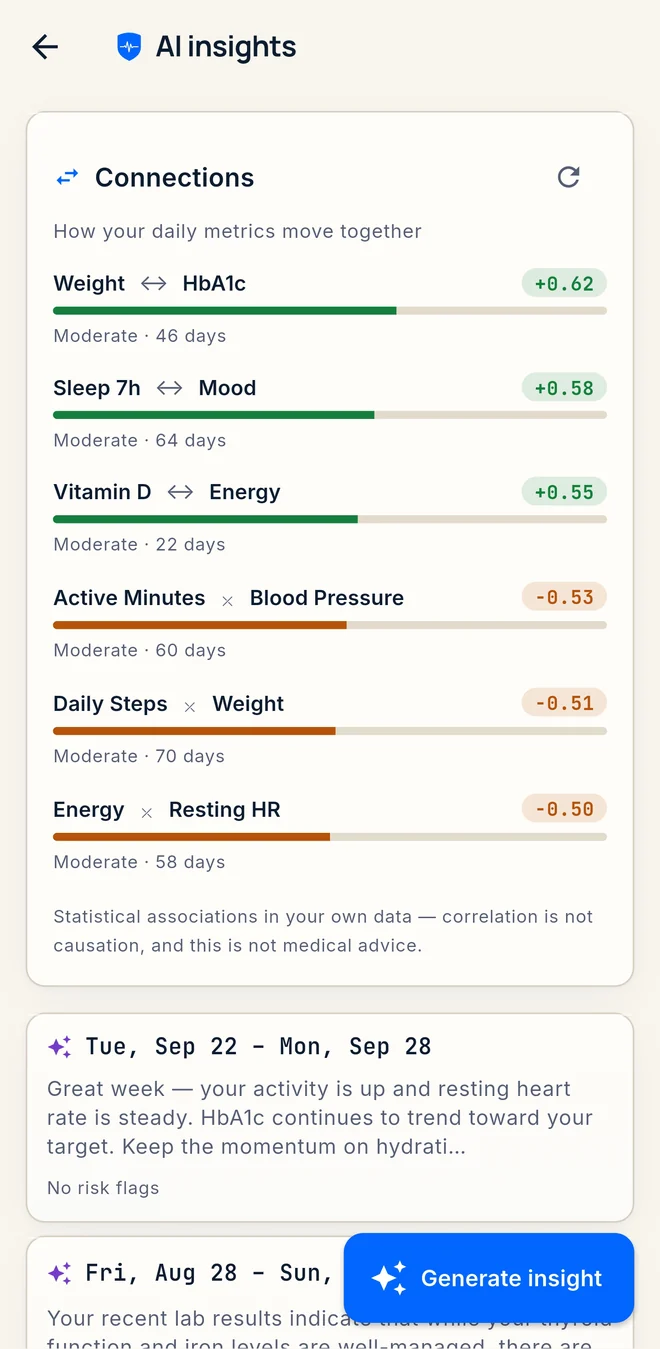
Every AI answer cites its sources, and the sources come from a catalog, not from the model's memory. App Store review asks medical apps to show where their health information comes from. The product answers with 26 medical sources, each read and dated by hand, with Indian guidance first — ICMR, the health ministry and Indian clinical societies — alongside the WHO, the NHS and US sources. The model may state a reference value only if it appears in that catalog or on the person's own lab report, and a citation the catalog does not hold is dropped rather than shown. Where a rule is Vaulth's own, such as an alert threshold, the app says so instead of borrowing a citation that does not support it.
Drug interaction checking stays on commercial models and authoritative sources, and is excluded from any self-hosting plan. It runs on every medication added, checks against the person's own allergies and conditions as well as their other medicines, and asks them to acknowledge what it finds.
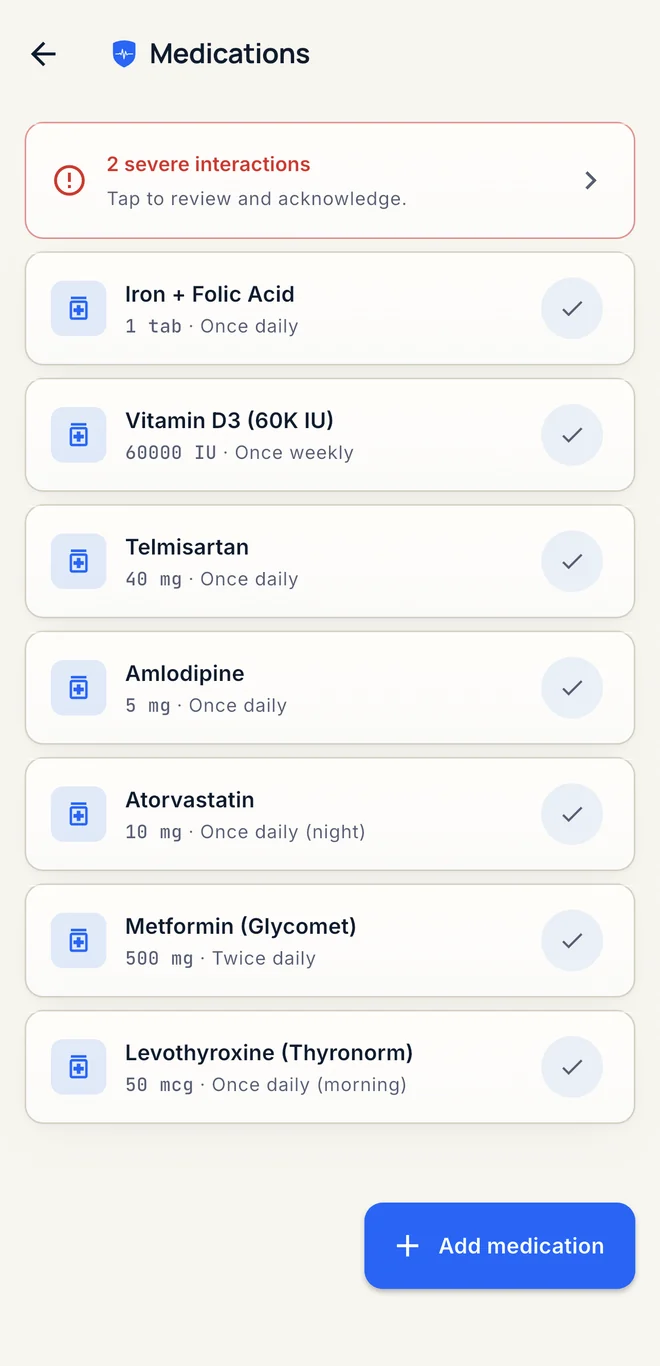
Traded away: cost control and independence on the one capability where independence would be worth most. Interaction checking is the capability I am least willing to own the failure of.