I started in design, moved into product, and kept following the work until I was building the
systems too. Today I’m the founder and sole engineer of Vaulth AI.
These are the parts I still think about: the choice I made, what I gave up, and why I’d make it again.
Vaulth AI · architecture
Consent isn’t a settings screen. It’s the product.
Seven caregiver scopes enforced across 62 API endpoints, every external view
token-gated and revocable, family circles that share a trend and never the raw number.
I said no to: taking custody in exchange for access. It would have
been faster to build and easier to fund, but it would have put the company in control.
Bank SMS, PDF statements, and CSV exports converge on one on-device pipeline: deterministic
rules for the common case, a small on-device model only for the uncertain tail.
I said no to: using the model for everything. That would have made
the app slower, more expensive to run, and harder to trust.
A 0.98 correlation on the ratings model was the most flattering number the project ever
produced. I read it as evidence of a problem and went looking for the leak.
I said no to: using it as the headline result. The number was
technically true and still gave the wrong impression.
A family's medical records should answer to the family.
In India those records are scattered further than the software assumes — hospital silos,
WhatsApp threads, prescription drawers, lab portals — and every existing answer has an owner
problem. Portals hold records hostage to one provider; aggregators take custody in exchange for
access. Vaulth's answer is that the family is the owner, and that consent, not storage, is the
product. I built the consent architecture first and hung everything else off it.
Stage
The platform runs — seven services, a mobile app across fifty-one screens in English and five
Indian languages, submitted to the App Store and Google Play for review. A Knowledge Library
and Vaulth for Doctors and Hospitals are in active development. DPDP-aligned and HIPAA-aligned, not certified; those are the words used
everywhere, including to customers.
Not building
Diagnosis. Anything that needed a second engineer to be safe. The aggregator business model,
which was both faster to build and easier to fund.
Learning
That working alone means manufacturing the friction a team gives you free — review, a
claims-verification step, blocking CI gates — or the work quietly gets worse in the exact places
nobody is left to look.
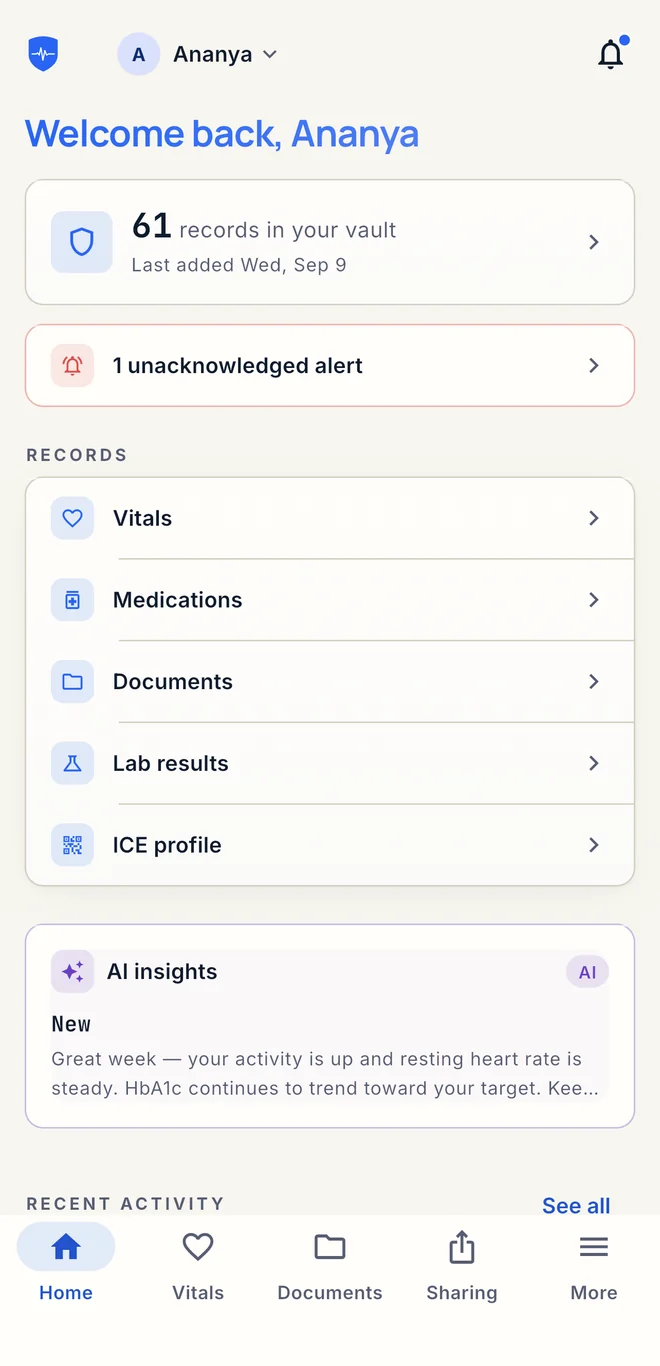
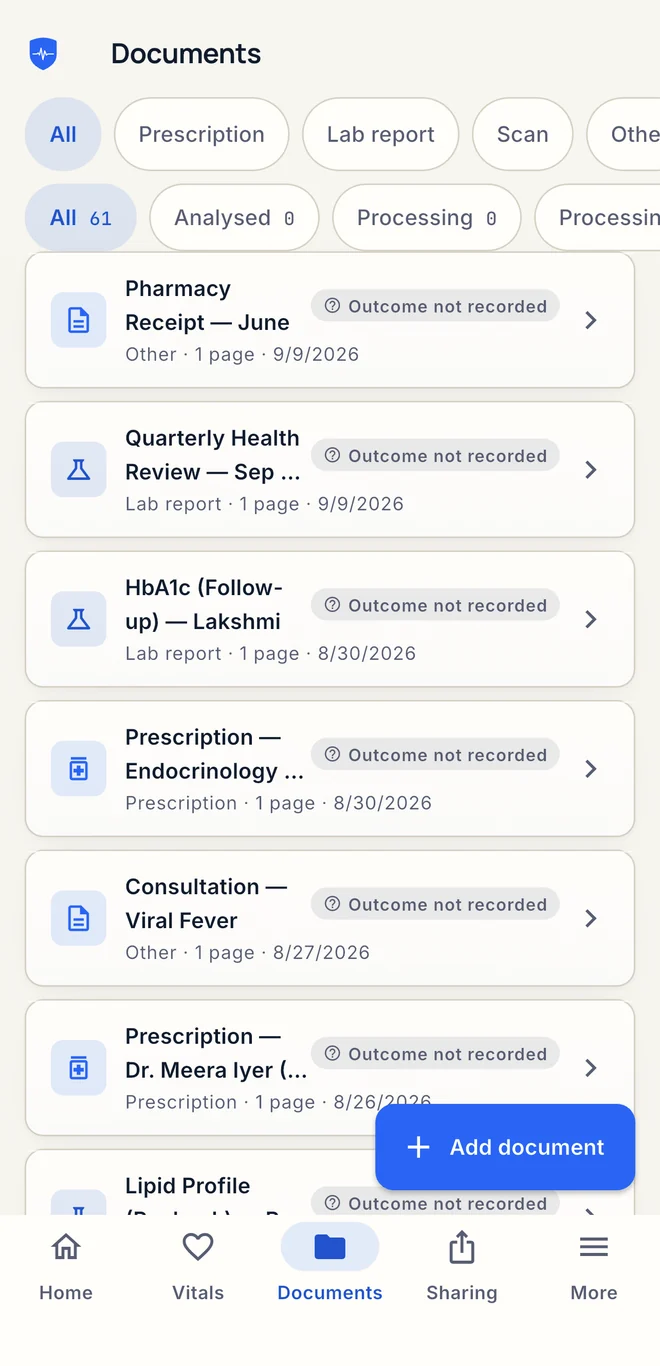
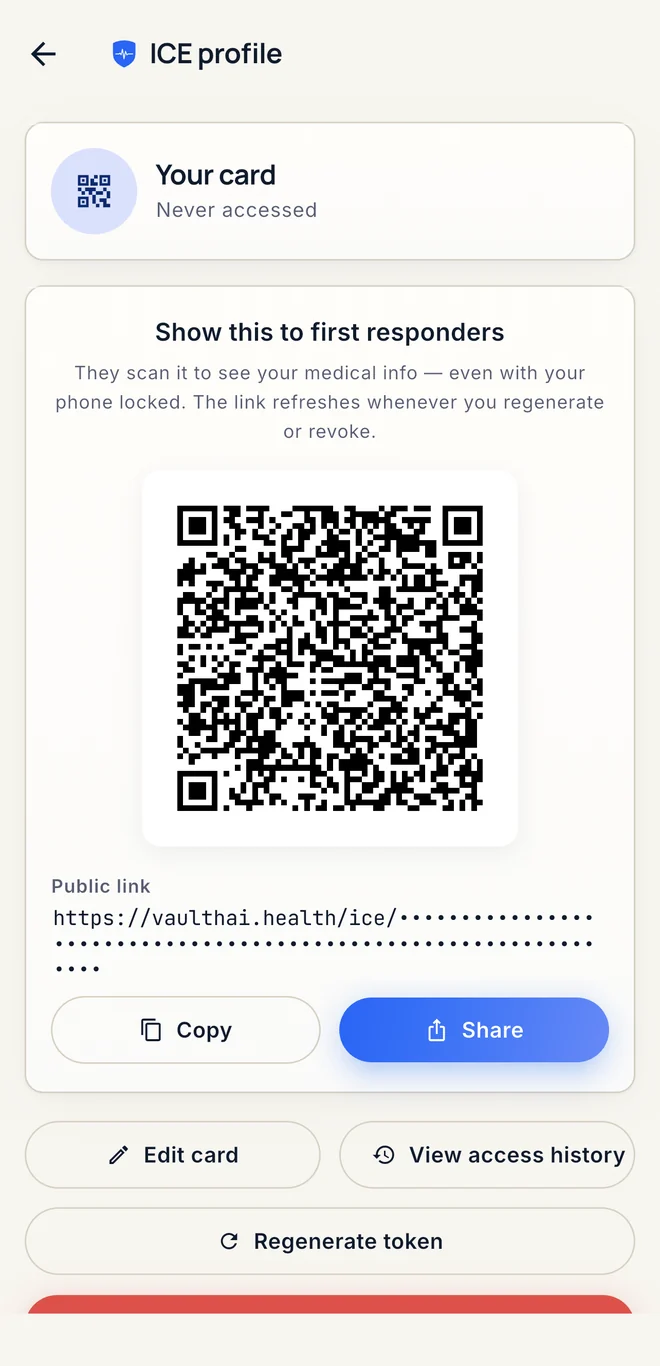
Fig. 01 — Home, the document list, and the emergency card with its access history and regenerate controls. Demo account, synthetic data; the QR code and token were replaced for publication.
Can a finance app understand your money without ever being told what it is? Bank SMS, PDF
statements and CSV exports parsed on-device by a deterministic-first cascade, with a small
on-device language model for the long tail.
How do you make a simulated cricketer behave like the real one — and how would you know if
you had failed? A ball-by-ball engine calibrated on 2.07 million real T20 deliveries, player
ratings adapted from the Earth Similarity Index, and a live event-sourced auction.
2.07M deliveries modelled0.98 correlation — rejected as headline
I have a hunch that source code is becoming another layer most people won’t work in directly,
much as assembly did before it.
If that’s even partly right, the interesting work moves toward choosing the problem, judging the
product, taste, systems thinking, understanding people, and distribution. The essay is me trying
to make that case honestly, including the evidence that makes me less certain.
Software is learning to write itself. Someone still has to know what's worth writing.