Every published claim carries an explicit confidence label: Confirmed, Partial, or Inferred. Gate reports are required to re-verify sign-off claims against the underlying evidence rather than accept them.
That rule exists because sign-off documents produced three consecutive false claims: an inverted recommendation, an invented figure, and a reversed encoding call. Three in a row is not carelessness, it is a systematic property of documents written by the party being assessed.
Two related checks fall out of it. AI-generated evaluations that inflate their scores on re-asking, award the top mark on whichever dimension flatters the subject most, or resolve every contested point in the subject's favour are treated as carrying a sycophancy signature, and held to the same evidence standard as any other claim. And characterization tests must include mutation verification — proving a negative assertion actually goes red when the behaviour changes, because a test that passes while testing nothing is worse than no test at all.
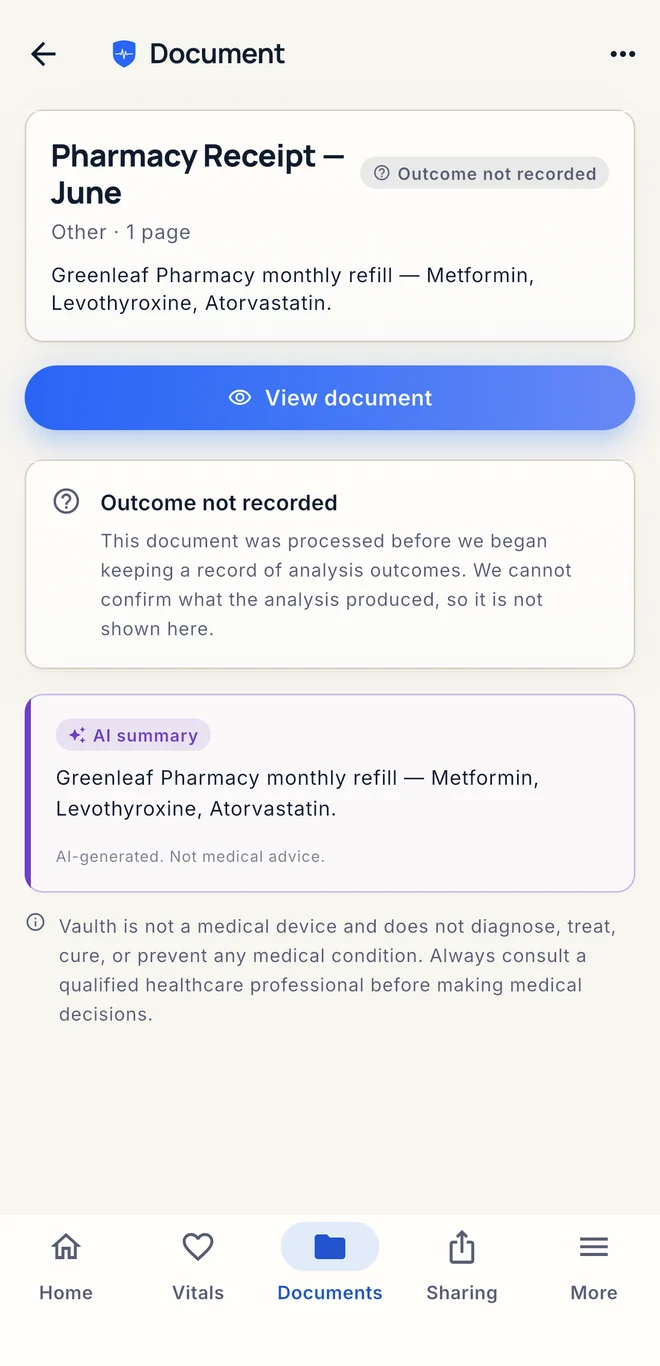
The same rule reaches the user. Analysis outcomes are now recorded for every document, lab extraction, insight and interaction check. For anything processed before that record existed, the app says so instead of presenting a result it cannot stand behind. A lab value the system cannot evaluate is shown as unknown, never as normal.
The failure mode I watch for by name is the one this whole section is closest to: optimising for artifact quality at the expense of operational reality. Constitutions, design systems and documents are easier to make excellent than observability, error handling and verified production behaviour. Every count on this page carries its own counting method and grep, cross-checked adversarially before publication, for that reason.